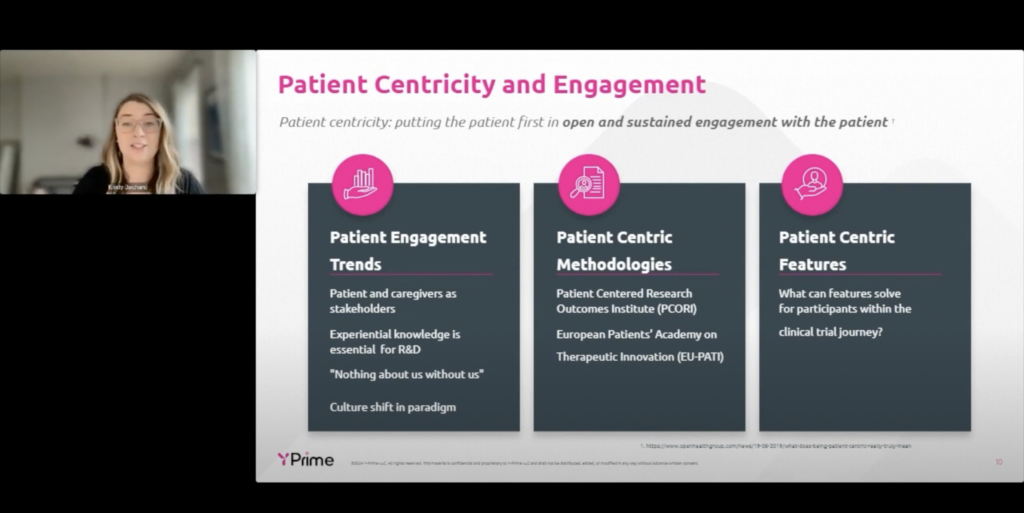
Patient-focused drug development (PFDD) in clinical trials has become a foundational expectation across regulatory bodies, sponsors, and technology providers. Defined as “a systematic approach to ensure patients’ experiences, perspectives, needs, and priorities are meaningfully incorporated into drug development and evaluation,” PFDD directly influences how clinical trial technologies are designed, deployed, and governed.
As clinical trials grow more complex and increasingly digital, incorporating the patient voice into eCOA and ePRO technology design is no longer optional. The primary goals of PFDD include improving enrollment, reducing participant burden, supporting sustained engagement, and ensuring that patient-reported data is reliable, complete, and fit for regulatory submission.
Developing ePRO with the patient in mind
Clinical trial stakeholders recognize the value of electronic Clinical Outcomes Assessment (eCOA), and, in particular, electronic patient-reported outcomes (ePRO) assessment in achieving PFDD-related goals while enhancing data accuracy and completeness. The use of computerized systems to collect PRO data in clinical trials is commonplace and the preferred and recommended method with regulators encouraging electronic instead of paper-based data collection.2-4
The key is for eCOA providers to interpret the data capture requirements of pharmaceutical sponsors’ clinical trial protocols and create solutions to facilitate ePRO data capture to support key endpoints. At the same time, in line with industry’s PFDD goals, solutions should be designed to enhance data quality in multiple ways including:

ePRO Best Practices
The recently published Best Practices for the Electronic Implementation and Migration of Patient-Reported Outcome Measures,5 which serves as a consensus on the best practices for ePRO migration and implementation, endorsed by the 23 eCOA technology or allied service providers that form Critical Path Institute’s eCOA Consortium. The goal of these best practices is to provide a definitive reference for user-friendly ePRO measure implementations that capture robust data5. Trial sponsors need technology that helps them ensure that the data they collect in their eCOA trials are of optimal integrity and fit for regulatory submission by adhering to these best practice recommendations and creating a “patient-engaging” solution for ePRO data collection.
User experience (UX) plays a very important role in software adoption and compliance.
At YPrime, participant focused drug development is not treated as a checkbox—it is embedded into how eCOA solutions are designed, implemented, and supported. Our eCOA platform is protocol-tailored and informed by direct user feedback to ensure participant experiences support—not hinder—trial execution.
By aligning eCOA and ePRO implementation with PFDD principles, sponsors and sites gain greater confidence in data quality, participant compliance, and inspection readiness—while delivering a trial experience that respects the realities of patient participation.
UI/UX for Participant Engagement in Clinical Trials
Participant engagement in clinical trials—reinforced through FDA PFDD initiatives—is a critical driver of compliance, retention, and endpoint completion. Even the most robust eCOA solution will fail if the user experience does not meet participant expectations.
User experience (UX) plays a very important role in software adoption and compliance. Even the most elegant eCOA solution design will not be useful or effective if it doesn’t engage the user. The eCOA UI must reflect diverse user feedback as well as the modern look and feel of some of the most popular software applications, rather than the standard, dry medical applications.
Let’s talk!
www.yprime.com/ecoa
marketing@yprime.com
YPrime’s eCOA solutions are protocol-tailored to meet the unique needs of each therapeutic area. Our advanced eCOA platform is designed and implemented by a team that is passionate about improving the daily lives of patients, sites, and sponsors.
To further enhance the trial experience of patients who use YPrime eCOA systems in clinical trials, we are developing a new patient engagement feature suite, based on feedback from diverse test users who indicated which features and functionality were the cleanest, most modern, fun, and easy to use. These features help the patient track protocol milestones, visit schedules, and eCOA protocol compliance in a fun and engaging way that has demonstrated engagement in diverse test users.
Sources
- U.S. Food and Drug Administration. CDER Patient-Focused Drug Development.
- Coons SJ, Eremenco S, Lundy JJ, O’Donohoe P, O’Gorman H, Malizia W. Capturing patient-reported outcome (PRO) data electronically: the past, present, and promise of ePRO measurement in clinical trials. Patient, 2015;8(4):301-309.
- U.S. Food and Drug Administration. Guidance for industry—Patient-Reported Outcome Measures: Use in Medical Product Development to Support Labeling Claims. December 2009
- U.S. Food and Drug Administration. Guidance for industry: Electronic Source Data in Clinical Investigations September 2013.
- Mowlem FD, Elash CA, Dumais KM, Haenel E, O’Donohoe P, Olt J, Kalpadakis-Smith AV, James B, Balestrieri G, Becker K, Newara MC, Kern S, on behalf of the Electronic Clinical Outcome Assessment (eCOA) Consortium: Best Practices for the Electronic Implementation and Migration of Patient-Reported Outcome Measures, Value in Health (2023)
Check out our other Participant Engagement Resources
about trial design, data capture, operational efficiencies, and, ultimately, solving for certainty in clinical research.