
A YPrime Blog By:
Mark Maietta
President,
YPrime

Obesity clinical trials are becoming more complex as sponsors evaluate next-generation therapies across longer study durations, broader global populations, and more data-intensive protocols. These studies often require frequent patient-reported assessments, longitudinal symptom tracking, quality-of-life measures, and ongoing participant engagement over many months.
For sponsors, the challenge is not only collecting more data. It is collecting reliable, complete, and audit-ready data while keeping participants engaged throughout the study. That is where electronic Clinical Outcome Assessment, or eCOA, plays a critical role.
YPrime eCOA in Action—A Global Phase 3 Obesity Study
YPrime supported a global pharmaceutical sponsor in a Phase 3 obesity and osteoarthritis study that required longitudinal participant-reported data collection over a treatment period of more than one year.
The study involved participants living with obesity and osteoarthritis and required ongoing collection of symptoms, pain, and quality-of-life data. Because participant-reported outcomes were central to understanding the treatment’s impact and usability; long-term engagement was critical.
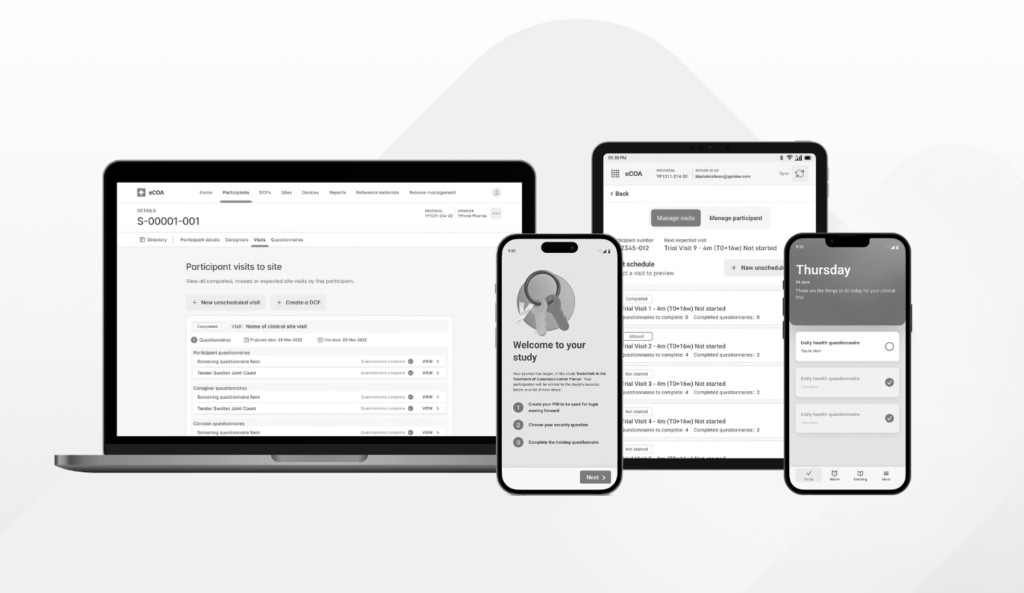
YPrime’s configurable eCOA platform supported the study by helping align assessment workflows to protocol requirements while reducing friction for participants. The solution enabled real-time data visibility, flexible assessment configuration, audit-ready data capture, and global deployment support.
Why Participant Engagement Matters in Obesity Research
Long-duration obesity clinical trials depend on sustained participant interaction with study technology. If participants do not understand what is expected, or if the reporting process feels burdensome, engagement can decline over time. This is especially important in chronic disease clinical trials, where the participant experience unfolds over months rather than days or weeks.
An effective eCOA experience helps participants stay oriented, complete assessments more consistently, and remain connected to the study workflow. For sponsors and CROs, this supports stronger data capture, fewer operational surprises, and greater confidence in endpoint data.
In some obesity and metabolic studies, participant safety monitoring is also a critical component of trial execution. Protocols that include assessments such as the Columbia-Suicide Severity Rating Scale (C-SSRS) require timely visibility into participant responses so sites can review potential safety concerns and respond immediately if needed. eCOA reporting capabilities can help support this process by providing clear visibility into participant-reported responses, helping sites monitor trends, review potential risks, and maintain oversight throughout the study.
The Growing Role of eCOA in Global GLP-1 Research and Obesity Trials
As obesity and metabolic research continues to expand, sponsors need eCOA platforms that can support increasingly complex global trial designs. This includes:
- Complex assessment workflows
- High-frequency patient-reported data collection
- Global study execution and localization
- Real-time operational visibility
- Participant-centered usability
- Inspection-ready data management
Sponsors and CROs are no longer evaluating eCOA as a simple replacement for paper. They need technology that can support scale, engagement, compliance, and data integrity in real-world clinical trial environments.
What’s Next with eCOA and GLP-1 and Obesity Trials
The future of obesity clinical trials will place even greater emphasis on participant-centered design, connected data collection, and long-term engagement. As protocols become more complex, eCOA will continue to play a central role in helping sponsors reduce participant burden, strengthen data quality, and manage global trial execution with confidence.
YPrime supports obesity, metabolic, and chronic disease clinical trials with scalable eCOA solutions designed for real-world clinical trial complexity, in addition to clinical trials supporting new cancer treatments to epilepsy, MDD, infectious disease and more.
Let’s Talk about eCOA for Your Next Clinical Trial
Learn how YPrime supports complex obesity and metabolic clinical trials with eCOA solutions designed to improve participant experience, support data quality, and reduce operational complexity.
Frequently Asked Questions
eCOA (electronic Clinical Outcome Assessment) is a digital solution used to collect patient-reported data during clinical trials. In obesity and GLP-1 studies, eCOA enables participants to complete assessments related to symptoms, quality of life, treatment experience, and other protocol-specific measures using smartphones, tablets, or provisioned devices. eCOA helps sponsors improve data quality, reduce missing data, and support participant engagement throughout long-duration studies.
Participant engagement is important because obesity and GLP-1 clinical trials often last many months or even years. Participants may be required to complete frequent assessments, report symptoms, and follow complex study schedules. When participants remain engaged and understand study expectations, sponsors are more likely to achieve higher assessment completion rates, better data quality, and stronger endpoint reliability.
eCOA improves data quality by enabling real-time data capture, reducing transcription errors, supporting protocol-driven workflows, and providing automated reminders for scheduled assessments. In obesity clinical trials, where patient-reported outcomes are often key endpoints, eCOA helps sponsors collect more complete, accurate, and audit-ready data while maintaining visibility into compliance and assessment completion trends.
Obesity clinical trials frequently collect patient-reported outcomes related to physical functioning, pain, mobility, treatment satisfaction, quality of life, daily activities, and symptom burden. These measures help sponsors evaluate how therapies affect participants beyond traditional clinical endpoints such as weight loss, body mass index (BMI), or metabolic markers. eCOA platforms help standardize and streamline the collection of these outcomes across global studies.
Sponsors should look for an eCOA platform that supports complex assessment schedules, multilingual deployment, participant-centered design, configurable workflows, real-time reporting, and inspection-ready data management. For global GLP-1 and obesity clinical trials, the ability to maintain participant engagement over long study durations while ensuring high-quality data collection is essential for successful trial execution.
Deliver eCOA With Confidence for Your Next Metabolic Trial
For clinical trial sponsors and CROs looking to strengthen their eCOA strategy, improve compliance, and reduce operational risk, YPrime provides the experience and insight needed to run trials with certainty.
To learn more about YPrime’s eCOA solutions, visit www.yprime.com/ecoa.
Check Out What Our Experts Have to Say
about trial design, data capture, operational efficiencies, and, ultimately, how to solve with certainty in clinical research.