
eCOA Participant Engagement Playbook
Participant Engagement in Clinical Trials
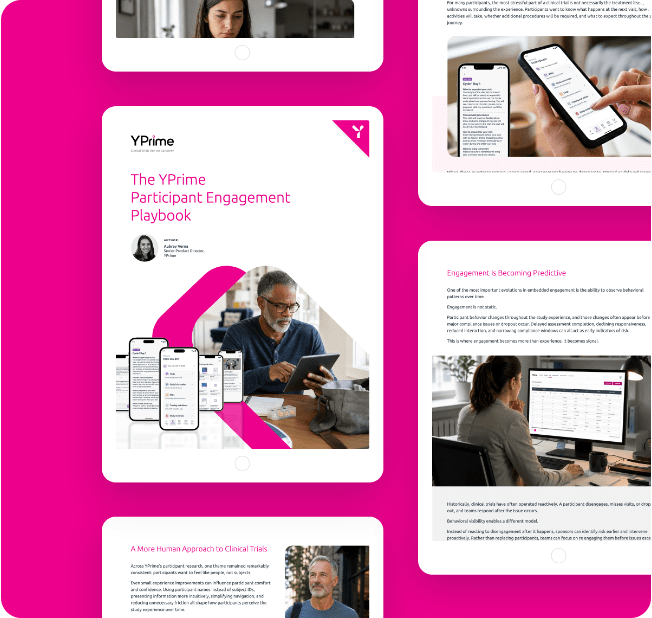
Adherence, retention, and missing data are some of the hardest problems in clinical trials, and the cause is rarely scientific. It is human.
Participants disengage gradually: a delayed assessment, a confusing visit, an activity that stops feeling connected to purpose. That friction becomes variability in participation, then variability in the data.
YPrime research across more than 500 global participants found something most engagement strategies get backwards. Participants were not asking for more features. They were asking to understand, and they wanted that support in the moment a question arose, not in a packet handed over at study start.
The playbook lays out what they told us, and what it means for teams designing trials around eCOA.
Download it here.
What’s in the Playbook
Participants ranked understanding above every reminder, reward, and badge we tested.


Participants were not simply asking to be reminded. They were asking to feel prepared.
– Aubrey Verna, Senior Product Director, YPrime
Participant Engagement FAQs
Participant engagement is how consistently and confidently participants take part in a study; completing assessments, attending visits, and staying enrolled. It is shaped less by incentives than by whether participants understand what is expected of them and why it matters, which ties it directly to adherence, retention, and data quality.
eCOA is the system participants interact with most, which makes it the natural place for engagement to live. Embedding study understanding, materials, and contextual reminders in the eCOA workflow puts support in front of participants at the moment of uncertainty, instead of in a separate portal they are unlikely to revisit.