

Ophthalmology clinical trials measure vision two ways. Clinical and imaging measures record what the eye does. Patient-reported outcomes (PRO) record what the patient can actually see, do, and tolerate. That half of the endpoint is still too often left on paper, or stranded in a module that does not integrate as it should with other systems.
eCOA in ophthalmology calls for a more careful approach than most therapeutic areas. Participants read the questionnaire with the vision challenges the questionnaire is measuring, which makes typeface, type size, contrast, screen layout, and response format part of how well the endpoint performs. Getting those right takes real familiarity with how low-vision participants use a screen.
Strong outcomes require eCOA built for low-vision use, per-eye data integrity, and audit-ready collection that holds at a global scale.
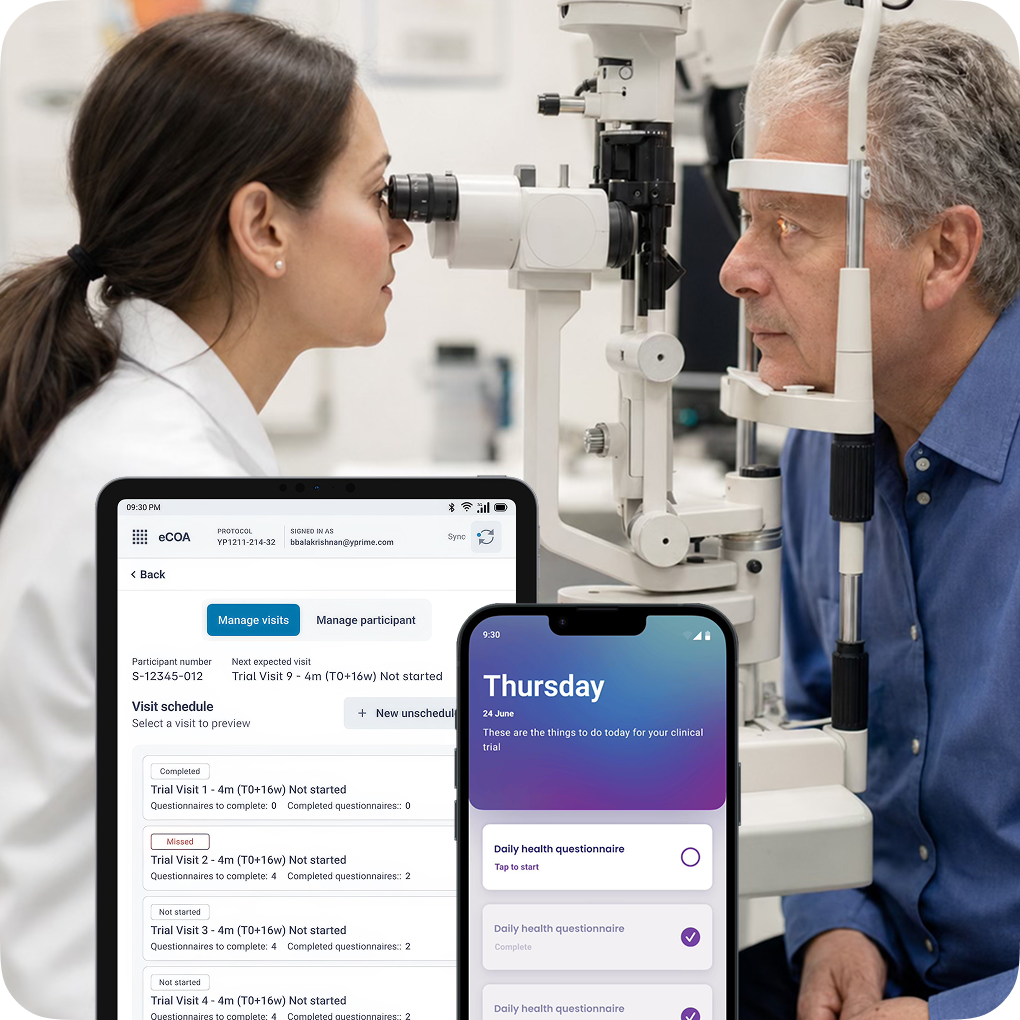
Why Ophthalmology Trials
Require Specialized eCOA

Bring visual function PROs off paper and out of disconnected modules

Keep every response tied to the correct eye, at every visit

Get eCOA, IRT, and eConsent, from one partner, so patient data and dosing decisions are not split across vendors
eCOA Case Study:
Proven in Ophthalmology and Device-Integrated Studies
In one ophthalmology study, a global biotechnology company approached YPrime for support on a Phase 1/2 glaucoma trial spanning 15 sites across several countries. As intraocular pressure fluctuates throughout the day, readings taken only at scheduled visits capture a fraction of the picture. The trial depended on participants taking their own measurements between visits, which meant the technology had to work in a participant’s home without a coordinator present.In one ophthalmology study, a global biotechnology company approached YPrime for support on a Phase 1/2 glaucoma trial spanning 15 sites across several countries. As intraocular pressure fluctuates throughout the day, readings taken only at scheduled visits capture a fraction of the picture. The trial depended on participants taking their own measurements between visits, which meant the technology had to work in a participant’s home without a coordinator present.
YPrime integrated a take-home tonometer into the eCOA environment for nearly 300 enrolled participants, sourcing and provisioning the instruments rather than ingesting device data alone. An instructional diary was delivered in each participant’s local language, guiding participants through each reading in defined windows ahead of scheduled visits. A virtual investigator meeting trained site teams on device use and participant instruction before first patient in.
All device data flows into a 21 CFR Part 11 compliant environment, giving the sponsor a validated record of readings taken between visits. Sourcing, provisioning, training, and integration were delivered under one scope of work, with one team accountable for getting the device into the participant’s hands and high-quality data into the study.
How YPrime Supports
Ophthalmology Studies

Validated visual function and vision-related quality of life instruments, plus the condition-specific measures ophthalmology protocols require

Per-eye data integrity that carries study eye and fellow eye designation through every assessment, timepoint, and export

Automated scoring and calculation logic built into the workflow, so scale scoring, visit windows, and eligibility checks are not left to manual work at the site

Accessible presentation for low-vision participants, including accessibility dark mode, with assessments designed to be completed independently or with assistance

Global language support, translation management, and instrument licensing expertise
eCOA Designed for Participants, Sponsors, and Sites
Ophthalmology trials require clarity at every level of execution. Participants need workflows they can complete with impaired vision, on treatment schedules that run for years, frequently with a caregiver or site staff member assisting administration. Sites need real-time insight into assessment completion, timepoint windows, and per-eye data consistency. Sponsors need visual function and quality-of-life data complete enough to stand beside the clinical and imaging measures collected elsewhere in the study. This alignment reduces friction and strengthens data quality across the study lifecycle.

Power Your Next Ophthalmology Clinical Trial
Whether launching a diabetic retinopathy or retinal disease study, optimizing an active glaucoma or inherited retinal disease trial, or planning your next ophthalmology program, the right eCOA or IRT foundation enables consistent execution at scale.
Start the conversation with our eCOA and IRT experts to see how YPrime supports ophthalmology clinical trials with the quality and flexibility these studies demand.
FAQs
eCOA (electronic Clinical Outcome Assessment) is the electronic collection of clinical outcome data including patient-reported symptoms, visual function measures, and study data in place of paper. In ophthalmology clinical trials it covers visual function questionnaires, symptom and eye drop diaries, per-eye assessment records, and protocol-defined activities, improving accuracy and reducing missing entries.
Ophthalmology studies pair objective vision measures with how patients function day to day, and the patient-reported half is the most underused. It is often still on paper or split across disconnected modules. eCOA standardizes how that data is collected, keeps every response tied to the correct eye and timepoint, and maintains audit-ready documentation throughout the study.
YPrime’s eCOA platform supports the visual function and vision-related quality of life instruments these protocols rely on, including VisQOL, the VFQ family across its several versions, NEI VFQ-25, and LVQOL, along with symptom and eye drop diaries, per-eye assessment workflows, and the condition-specific measures ophthalmology protocols often require.
YPrime’s eCOA platform supports accessibility dark mode and simplified response formats, so participants with reduced visual acuity can complete assessments consistently across visits — independently, or with a caregiver or site staff member assisting.
Yes. YPrime provides both eCOA and IRT (Interactive Response Technology), so randomization, visit scheduling, and dosing decisions sit with the same partner as your patient-reported data — one team accountable for how the two work together, instead of two vendors pointing at each other.