
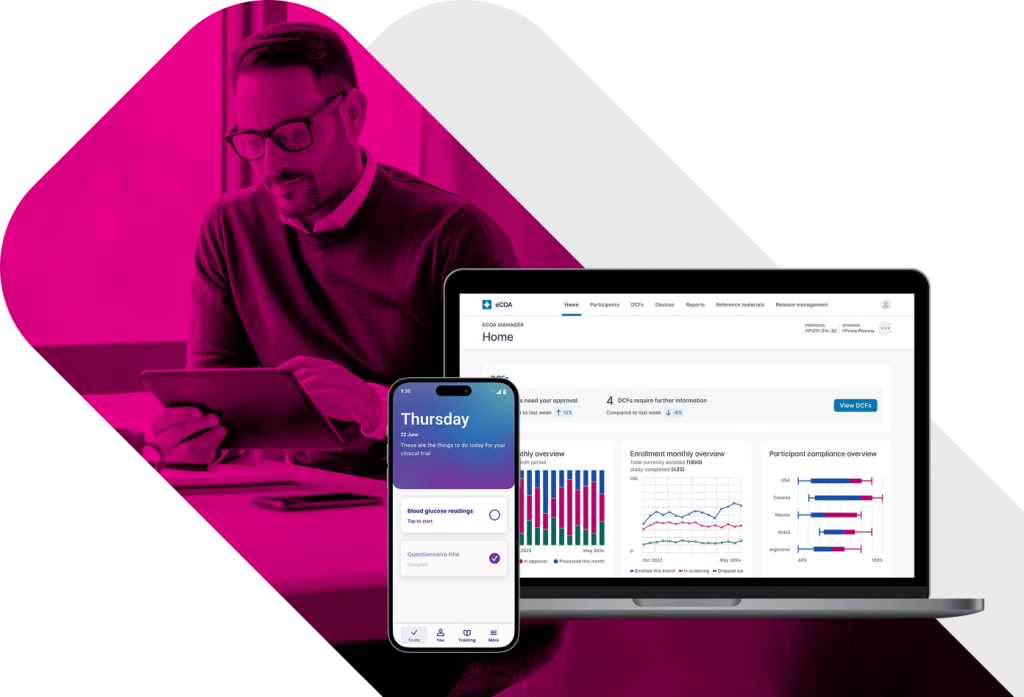
IRT & RTSM For Clinical Trials
IRT for Clinical Research.
Speed, flexibility and certainty for complex global trials.
YPrime IRT is interactive response technology and randomization and trial supply management (RTSM) for the industry’s most demanding studies, backed by 20+ years of dedicated IRT experience and a fully in-house support model.
Analyst recognized
Leader Everest Group’s
2025 eCOA PEAK Matrix®


What is IRT
IRT Is More Than a Randomization Tool. It’s Trial Infrastructure.
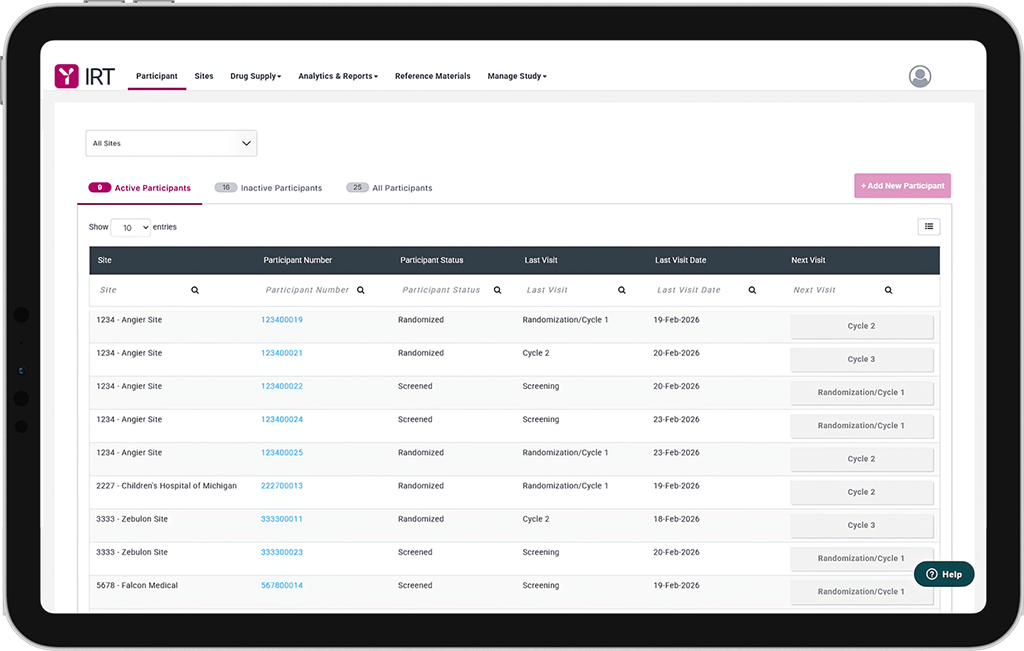
Interactive response technology (IRT), also called randomization and trial supply management (RTSM), is the clinical trial technology that randomizes participants, assigns treatment, protects the blind, and keeps investigational product moving from depot to site. When it works, the study runs. When it lags, everything downstream lags with it.
Today’s trials evolve faster than ever. Protocols change, timelines shrink, and complexity increases at every stage. YPrime IRT is the platform industry leaders trust to run their most demanding studies. From early-phase oncology to global platform trials, YPrime IRT empowers sponsors and CROs to deploy faster, adapt with confidence, and maintain visibility across subjects, sites, and supply.
The YPrime IRT Framework
Three commitments shape how every YPrime IRT study is built, run, and supported.

Speed
Rapid IRT study startup and self-service study changes keep first-patient-in and protocol amendments on schedule.
Your timeline sets the pace of our IRT build.

Flexibility
A flexible platform is built to absorb protocol changes without triggering a full amendment cycle, so teams keep moving.
When a protocol doesn’t fit the box, our IRT adapts.

Certainty
Dependable data, reliable reporting, and trusted timelines are backed by fully in-house, protocol-trained support.
It’s a promise: YPrime keeps your IRT data inspection-ready, always.
YPrime Data Suite
IRT Reporting and Live Trial Data with the YPrime Data Suite Access live trial insights, not last month’s export.
Most sponsors still find out about problems after an export, after a query cycle, after interim analysis. By then a missed visit pattern is a protocol deviation. The Data Suite combines high-performance IRT and eCOA reporting with real-time data integration, so your team sees what’s happening across every site, subject, and system.
Explore the Data Suite →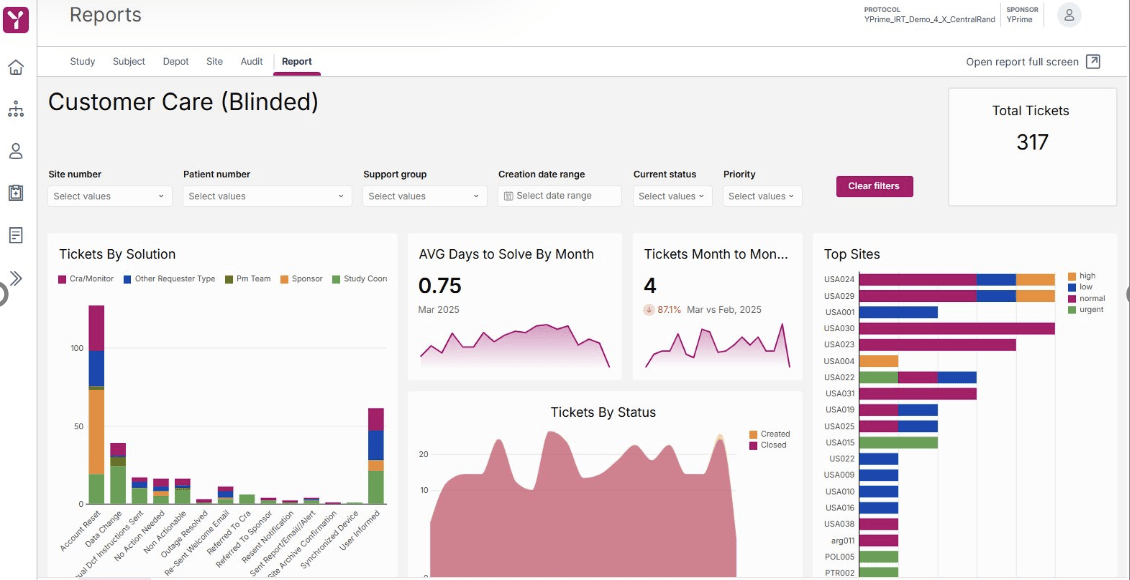
An Industry-Leading IRT Track Record
YPrime combines deep IRT expertise with a fully in-house support model, so sponsors and CROs get dependable performance backed by real numbers.
Get Startedmissed go-lives
ticket SLA achieved*
customer satisfaction score*
first call resolution*
What Sets YPrime IRT Apart
Six capabilities sponsors and CROs cite most often when they move randomization and trial supply management to YPrime.

Actionable reporting
A modern high-speed data warehouse delivers randomization, enrollment, and supply data that’s organized and ready to act on.

Robust self-service
Manage countries, depots, sites, users, cohorts, and resupply rules yourself, without delays or change orders.

Cohort management
Advanced cohort control tied to dosing and visit tracks, ideal for dose-finding and adaptive designs.

Seamless integrations
Easy, repeatable connections across labs, distribution systems, EDC, eCOA, CTMS, and more.

In-house help desk
24/7/365 protocol-trained support from YPrime experts who know both your study and the technology.

Flexibility for complexity
Most IRT is optimized for either standardization or customization. Our architecture enables rapid deployment with flexibility to support complex protocol logic.
“This level of customer service was beyond anything I have received through other vendors, and I have been in the industry for 15+ years. I will definitely be adding YPrime to our preferred vendor list.”
— Site Contact, 2025
IRT Case Study · Immunotherapy / Food allergy
YPrime IRT in Action: Three Randomizations While Maintaining the Blind
When subjects stop treatment, but randomization must continue
A combination biologic and oral immunotherapy trial for peanut allergy required more than a single randomization event. More than 150 subjects were randomized in an initial double-blind phase, stratified by screening peanut allergy levels and body weight, with minimum enrollment requirements per weight category.
At a pre-defined milestone, subjects were re-randomized into new treatment arms based on whether they reached a maintenance threshold. Subjects who missed that threshold, or discontinued early, still went through a randomization call to generate a hypothetical assignment, preserving the blind and supporting intent-to-treat analysis. Subjects on placebo followed the same rule in reverse.
Read the full case study →One trial carrying three independent randomization layers, each with its own logic and its own risk to the blind.
Initial treatment assignment
Double-blind randomization of 150+ subjects, stratified by allergy level and body weight, with minimum enrollment per weight category.
Conditional re-randomization at the maintenance milestone
New arms assigned on whether a subject reached the threshold, with hypothetical assignments for those who missed it or discontinued early.
Independent challenge-day sequencing
Sequenced food challenges required their own re-randomization process, run independently of treatment assignment.
Bespoke randomization logic other IRT systems can’t support, delivered with the blind and the audit trail intact.
IRT Case Study · Oncology
Top-5 pharma stopped waiting weeks on every amendment
A sponsor was amending its adaptive oncology protocol faster than its incumbent RTSM vendor could implement changes. Every amendment meant a change order, a queue, and weeks of waiting while sites held enrollment. The sponsor reached out to YPrime for support. We were able to provide a new IRT system and include the protocol changes faster than the incumbent vendor could make changes to the existing system.
Early-phase oncology build to go-live
Countries on one global study
Cohort, site, and resupply changes
Missed go-lives
IRT Essentials
Right-Sized IRT for Phase 1 and 2a Studies Built for your study today. Ready as research evolves.
Early-phase studies are smaller in scale, but the need for visibility, control, and auditability is no less critical. YPrime IRT Essentials replaces spreadsheets and manual trackers with a validated, auditable system, giving lean teams a comprehensive set of functionality for what the study needs, without what it doesn’t. It runs on YPrime’s proven IRT platform, so capability can be added if complexity arrives.
What your team gets
Participant management
Know where every participant is in their journey.
Screening through completion: enrollment, visits, dispensation, replacement, and discontinuation in one live record instead of a tracker.
Randomization & blind management
Protect the blind and the integrity of your data.
Randomize in a validated system with controlled unblinding, cohort management, and enrollment caps, with every action time-stamped.
Supply & materials management
Stop guessing whether the site needs IMP.
Inventory, orders, resupply, kit replacement, and dispensation across sites and depot, visible before a stockout affects a visit.
Reporting & auditability
Answer the question in seconds, not days.
Standard reports and alerts plus an immutable audit log, with oversight in real time and inspection readiness from day one.
One IRT platform supports every trial member.
IRT is not only a clinical supply system. Safety teams unblind in it. Quality is inspected on it. Supply depends on it.
IRT Proven at Global Scale
A track record built over two decades, with the scale and reach to support the industry’s most demanding programs.
Sites supported
Patients supported
Therapeutic areas (eCOA & IRT)
Solve with certainty
Bring us the protocol everyone else called complicated.
We’ll walk your design, show you the platform, and give you the timeline we intend to hit. Zero missed go-lives, and we plan to keep it that way.
Let’s talk IRT
Whether you’re selecting IRT for a first-in-human study, planning a global platform trial, or replacing an RTSM system that can’t keep up with your amendments, the right foundation decides how much of your timeline you actually control.
Bring your protocol, your amendment history, and your integration list. Those three tell us most of what we need.
Talk to an IRT expertInsights
IRT and RTSM Insights From Our Experts
View all insights →
Case Study: Faster IRT Startup in 45 Countries
Case Study: YPrime IRT in Action: Rapid COVID-19 Vaccine Study Implementation in Under 4 Weeks
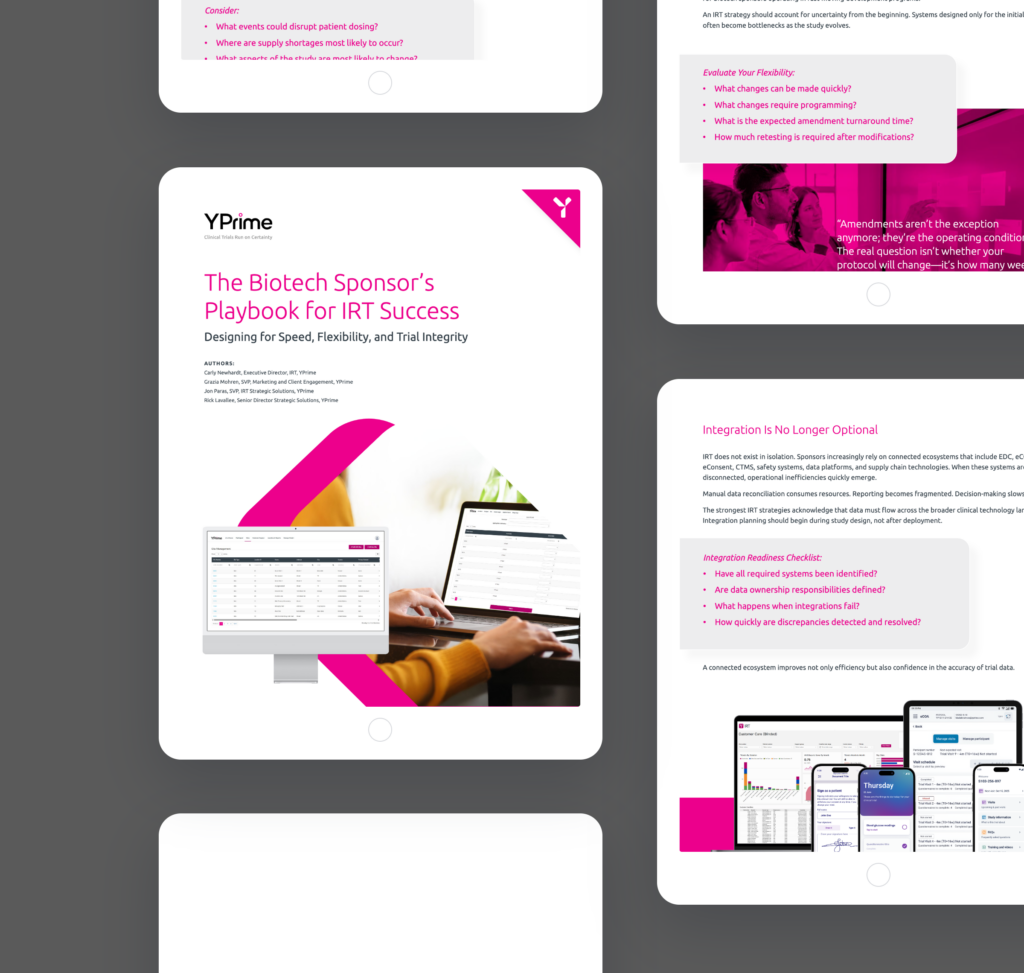
The Biotech Sponsor’s Playbook for IRT Success
IRT and RTSM questions, answered
The questions sponsors and CROs ask most often when evaluating IRT for clinical trials.
What is IRT in clinical trials?
Interactive response technology is the clinical trial technology that randomizes participants, assigns treatment, protects the blind, and manages investigational product across sites and depots. It also produces the audit trail regulators expect, which is why IRT functions as trial infrastructure rather than a single-purpose randomization tool.
Is RTSM the same as IRT?
Effectively, yes. Randomization and trial supply management (RTSM) and IRT describe the same category of clinical trial technology. RTSM names the two core jobs of the system; IRT is the broader term most sponsors and CROs use.
How long does a protocol amendment take to implement?
Sponsors report roughly six weeks on average across the industry. YPrime IRT is built to absorb protocol changes without triggering a full amendment cycle: routine operational changes are self-service and immediate, and higher-impact changes are implemented, validated, and documented by YPrime study teams so the study stays inspection-ready.
How fast can an IRT study go live?
Your timeline sets the pace of the build. An early-phase oncology trial with complex stratifications and frequent protocol changes was deployed in under four weeks, and IRT Essentials studies with a defined scope can go live in as little as a week for the simplest designs.
Which changes can our team make ourselves?
Countries, depots, sites, users, cohorts, dispensing levels, and resupply rules are all self-service. Changes that touch randomization logic, study arms, or blind management are implemented and validated by YPrime so documentation and inspection readiness are preserved.
What randomization methods does YPrime IRT support?
Permuted block and stratified randomization, dynamic allocation and minimization methods including Pocock and Simon biased coin, covariate-adjusted balance across multiple stratification factors, enrollment caps by stratum, multi-phase and conditional re-randomization, and independent randomization layers within a single study.
Does YPrime IRT integrate with EDC, eCOA, and CTMS?
Yes. Easy, repeatable connections run across labs, distribution systems, EDC, eCOA, eConsent, CTMS, and data lakes, so randomization and supply data land where your team already works.
How does YPrime IRT support clinical supply management?
Inventory, orders, resupply, kit replacement, and dispensation are managed across sites and depots, with visibility before a stockout affects a visit. Depots, countries, and resupply rules can be adjusted by your own team as enrollment shifts.
What support do sites actually get?
A 24/7/365 in-house help desk staffed by protocol-trained YPrime experts who know both the study and the technology, including direct site and participant support built on our eCOA experience. In 2025: 97.6% ticket SLA achieved, 93.1% customer satisfaction, 90.7% first call resolution.
Do you support early-phase and smaller studies?
IRT Essentials is right-sized IRT for Phase 1 and 2a studies, replacing spreadsheets and manual trackers with a validated, auditable system. It runs on YPrime’s proven IRT platform, so capability can be added if complexity arrives.
Which therapeutic areas does YPrime IRT support?
19+ therapeutic areas across eCOA and IRT, including oncology, cardiovascular, immunology and autoimmune, rare disease, neurology, respiratory, vaccine and infectious disease, metabolic and endocrine, hematology, gastroenterology, dermatology, nutrition, and food allergy and immunotherapy.
How should we evaluate an IRT vendor?
Ask how long a mid-study change takes and who performs it, which changes your own team can make, how randomization and supply data reach your analytics environment, who answers when a site calls at 2 a.m., and what the vendor’s go-live record actually is. YPrime reports zero missed go-lives.
Let’s talk IRT
Whether you’re selecting IRT for a first-in-human study, planning a global platform trial, or replacing an RTSM system that can’t keep up with your amendments, the right foundation decides how much of your timeline you actually control.
Bring your protocol, your amendment history, and your integration list. Those three tell us most of what we need.
Running an early-phase study? Ask about IRT Essentials.