

A YPrime Blog By:
Mark Maietta
President,
YPrime
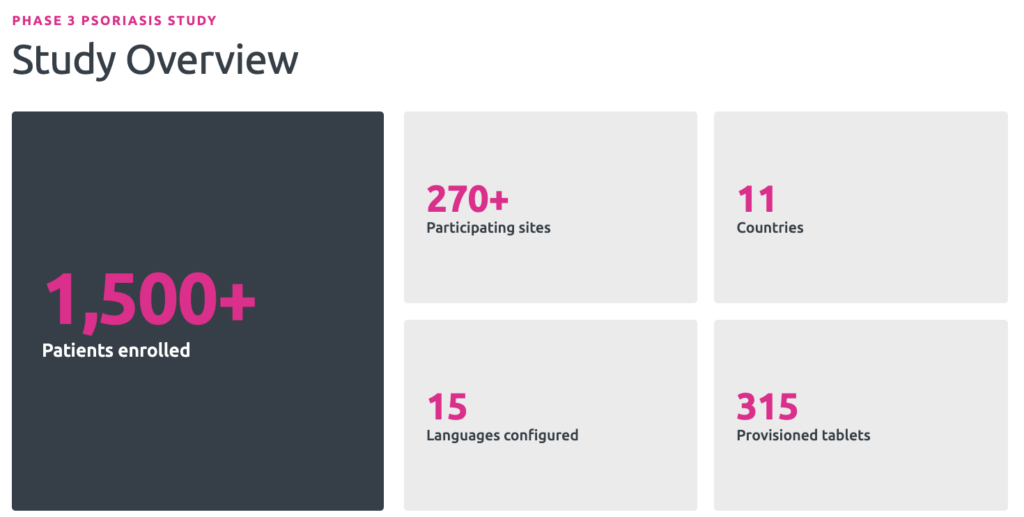
A biotechnology company developing an oral therapy for moderate-to-severe plaque psoriasis came to YPrime with a Phase 3 extension study that had to run identically in 11 countries at once: more than 1,500 patients, 270 sites, 15 languages.
The hard part was not scale. It was scoring. Psoriasis assessments combine affected body surface area with disease severity, and those calculations happen at the site, by hand, under time pressure. Every manual step is a place where two sites can diverge.
To deliver certainty, we built the calculation into the workflow. Raters entered what they observed; the system produced the score, the dosing guidance, and the protocol-defined next step, including whether rescue treatment was indicated.
That is what eCOA for dermatology clinical trials looks like, when it is built for the indication rather than adapted to it.
The Challenge: Global Scale in a Dermatology Clinical Trial
The sponsor needed a site-based eCOA deployment with provisioned devices across more than 270 sites in 11 countries and 15 configured languages — running on a protocol that would change mid-study.
Every variable multiplies data quality risk. A scoring convention that drifts slightly in one region becomes noise in the endpoint data. A protocol amendment has to reach all 315 tablets without leaving a single site on the old logic.
The Solution: eCOA with Automated Calculation Logic
YPrime designed the workflow around the psoriasis assessment itself. The scoring is composite by nature, the extent of involvement is combined with severity and judged across multiple body regions. We embedded that logic in the eCOA workflow so the rater observes and the system calculates.
Assessment data converted directly into dosing guidance and next-step decisioning, including rescue treatment determination. Every output was traceable.
The principle was simple: the system calculates, the investigator decides.
The solution provided:
- Assessment workflows designed for psoriasis studies
- Automated calculation logic
- Dosing guidance based on assessment results
- Protocol-defined next-step decisioning
- Rescue treatment determination
- Full auditability and inspection readiness
The Results
The program met all primary and secondary endpoints. It exceeded enrollment goals and completed ahead of schedule.
Key outcomes included:
- Achievement of all primary and secondary endpoints
- Elimination of manual assessment calculations at the site level
- Consistent clinical decision-making across regions
- Full auditability and inspection readiness maintained throughout the program
“The scale looked like the hard part, but it wasn’t. Composite scoring done by hand is the hard part. You can train 270 sites carefully and still get drift, because the arithmetic happens at the end of a long visit. Once we moved the calculation into the workflow, that whole category of variability stopped being something anyone had to manage.”
— Mark Maietta, President, YPrime
The Future of eCOA in Dermatology Clinical Trials
As dermatology research grows more complex, sponsors need technology that handles composite scoring, deploys across regions and languages, and absorbs protocol amendments mid-study without leaving sites on old logic.
YPrime’s dermatology-ready eCOA platform is built for those conditions: purpose-built workflows, automated calculation logic, global deployment, and an in-house 24/7 site help desk.
Frequently Asked Questions
Electronic Clinical Outcome Assessment (eCOA) replaces paper-based clinical trial data collection with validated digital workflows. In dermatology trials, eCOA captures rater assessments such as PASI, IGA, and BSA, performs the scoring calculations, and drives protocol-defined next steps from the results.
The eCOA captured affected body surface area and disease severity directly, with scoring logic built into the workflow. Raters entered their observations; the system produced the composite score, the resulting dosing guidance, and the protocol-defined next step, including rescue treatment determination. No manual calculation was performed at the site.
The study enrolled more than 1,500 patients across more than 270 sites in 11 countries, with 15 configured languages and approximately 315 provisioned tablets deployed.
Dermatology assessments rely on scoring that combines affected body surface area with disease severity, often across multiple body regions. These calculations are performed at the site, frequently under time pressure, and small errors can affect dosing decisions and endpoint data. Dermatology-specific eCOA workflows embed the scoring logic in the product itself, so results are calculated consistently across every site and region rather than depending on manual work at the point of care.
Psoriasis trials typically rely on three assessments: Body Surface Area (BSA), the percentage of skin affected; the Psoriasis Area and Severity Index (PASI), which combines the extent of involvement with the severity of redness, thickness, and scaling across four body regions; and the Investigator’s Global Assessment (IGA), a single rater judgment of overall disease severity. PASI in particular requires the rater to score multiple regions and then combine them, which is where manual calculation errors enter.
Deliver eCOA With Confidence for Your Next Dermatology Trial
For sponsors and CROs running dermatology programs, the pattern holds beyond psoriasis: assessments that depend on precise scoring and multi-region deployment benefit most when the eCOA is built around those requirements rather than adapted to them.
YPrime works with sponsors and CROs to configure that foundation before FPI, where it costs the least—and protects the most.
Learn more about YPrime eCOA.
Check Out What Our Experts Have to Say
about trial design, data capture, operational efficiencies, and, ultimately, how to solve with certainty in clinical research.