

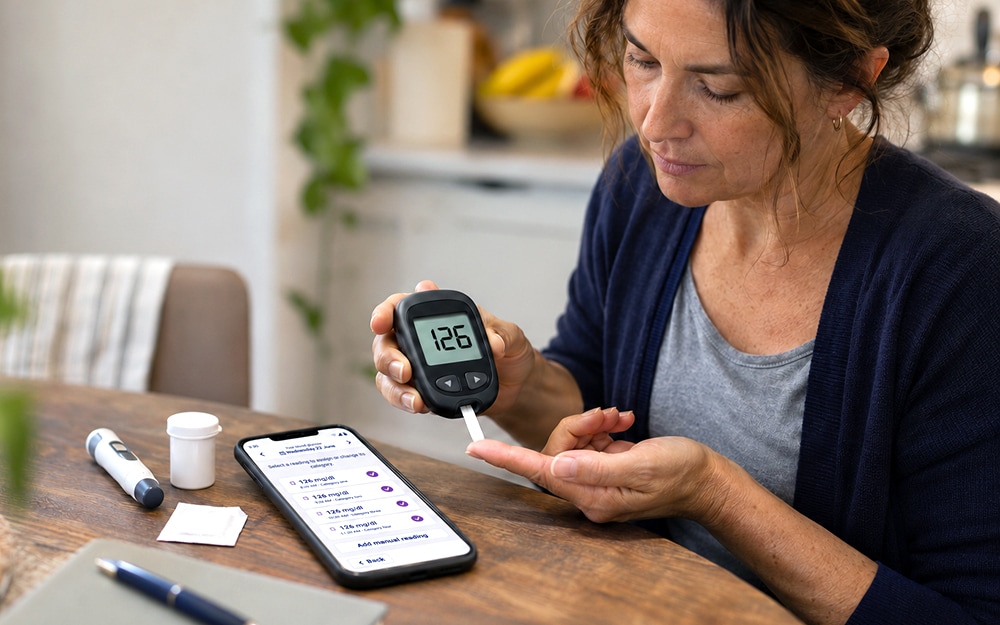
Every GLP-1, diabetes or obesity trial comes down to a small moment, repeated thousands of times. A participant pricks a finger, the meter shows a number, and that number must reach your database exactly as it happened.
Too often, it doesn’t. A digit gets flipped, a diary gets filled in late, a low never gets logged. Each slip looks minor in the moment and resurfaces later as a query, a protocol deviation or a question from an inspector.
Glucometer eCOA closes the gap between the meter and the database. When the meter syncs directly to eCOA, every reading flows into the study record automatically: timestamped, paired with the participant’s diary entries and traceable to the device that captured it. No transcription. No reconciliation. Here’s what it takes, and what to ask before your next metabolic study.
Why paper glucose diaries fail in clinical trials
Manual glucose logs fail in predictable ways, and each one hits the endpoint.
Transcription errors.
A patient writes 85 instead of 58, and a hypoglycemia event disappears.
Backfilled diaries.
Paper diaries are often completed in the waiting room. In a landmark BMJ study, patients reported 90% paper diary compliance while actual compliance was 11%.
Missing context.
A reading with no time, meal status or symptoms cannot support a hypoglycemia endpoint.
Late safety signals.
A severe low surfaces weeks later at the next site visit, not the day it happened.
Reconciliation burden.
Data managers match meter memory against diary pages by hand, query by query.
What a connected glucometer study looks like
In a connected study, the patient takes a fingerstick and the rest happens without a pen.
Capture.
The meter sends the reading to the eCOA app over Bluetooth with the meter’s timestamp, checked against the app clock to catch drift.
Context.
The app asks for context at the same moment: fasting, before or after a meal, symptoms, and rescue treatment.
Rules.
A value below the protocol’s hypoglycemia threshold (e.g., under 70 mg/dL) or above its hyperglycemia threshold (e.g., over 180 mg/dL) can open a symptom event form and alert the site.
Audit trail.
Device ID, time sync and the original value stay in the audit trail as source data.
The result is fewer queries, faster safety reviews, and an endpoint dataset you can defend.
When the sync fails
Devices drop connections in the field. The question is whether your eCOA flags it before a gap reaches the dataset.
| Real-world failure | Risk to the trial | What your eCOA should do |
|---|---|---|
| Bluetooth sync fails | Lost or late readings, missed endpoints | Switch to manual eCOA entry so capture never stops |
| Patient uses a different meter | Inconsistent data, protocol deviations | Tag the source of every reading |
| Manual and synced entries overlap | Duplicate values, costly reconciliation | Mark the duplicate invalid after sync |
| Patient mistypes a manually entered value | Inaccurate data | Allow corrections in a configurable edit window, fully audited |
| No record of where a value came from | Inspection risk | Label each entry Bluetooth, manual or edited |
What regulators expect from connected device data
Regulators now treat a connected glucometer as a digital health technology (DHT), and they expect a plan for it.
A strong data warehouse that provides key insights and analysis across studies
Advanced checks to maintain high data standards
Complete audit trails that protect data quality and integrity
Clean glucose data for GLP-1 and diabetes trials
In a GLP-1 study, glucose data is not a side metric. It drives dosing decisions, safety review and the endpoints your submission rests on. The meter is only half the system. The other half is the eCOA that catches what the meter misses.
YPrime eCOA is built for that half. Readings sync from the meter, manual entry takes over if Bluetooth fails, duplicates are marked invalid, and every value carries its source. Real-time alerts flag what is missing or questionable while there is still time to fix it.
We have supported GLP-1 research across type 2 diabetes, obesity, pediatrics, polyendocrine metabolic ovarian syndrome (PMOS), knee osteoarthritis, and sleep apnea. Wherever your program goes next, your glucose data should arrive clean.
Planning a GLP-1, obesity or diabetes study? Talk to our eCOA team.
Talk to our eCOA teamGlucometer eCOA FAQ
What is glucometer eCOA?
Glucometer eCOA connects a blood glucose meter to an electronic clinical outcome assessment app. Readings flow into the patient’s eDiary automatically, with timestamps, context and an audit trail.
Does a connected glucometer replace the glucose diary?
It replaces typing in the number. The diary still captures what the meter cannot: meal timing, symptoms and treatment.
Can patients use their own glucometer in a trial?
Usually not. Sponsors provision one validated meter so every reading is comparable. The eCOA app itself can run on the patient’s own phone.
Which trials need glucometer eCOA?
Diabetes, obesity, GLP-1 and other metabolic studies, plus any trial with hypoglycemia as a safety signal.
Questions to ask your eCOA vendor
eCOA device integration is the easy part. These questions show whether your data stays clean for the life of your study.
Devices
Device support: Which glucometers do you support and have validated today?
Pairing failures: What happens when pairing fails or a patient replaces a meter mid-study?
BYOD: Can one study run provisioned devices and bring-your-own-device (BYOD) side by side?
Data integrity
Timestamps: Whose clock stamps the reading: the glucometer, the phone or the server?
Audit trail: Does glucometer data share the same audit trail as diary and PRO data?
Data delivery: How does data reach us: raw files or CDISC-ready datasets?
Study setup
Real-time alerts: Can a reading trigger symptom forms and site alerts in real time?
Build speed: How fast can you build a glucose diary study, including translations?